



Choosing the right platform through an ecommerce platform comparison can make or break your online business. Shopify alone hosts over 1 million eshops and captures 28% of e-commerce worldwide. The competition among platforms is fierce. Each ecommerce platform offers different strengths, from pricing and ease of use to scalability and marketing tools. Finding the best ecommerce platform for small business needs requires understanding what each option brings to the table. This piece breaks down the top e-commerce platforms and compares everything in them. You’ll know exactly which platform lines up with your business goals and budget.
Key Factors to Consider When Comparing Ecommerce Platforms

Image Source: Metacake
Before comparing specific e-commerce platforms, understanding what drives long-term success helps you avoid pricey mistakes. The monthly subscription fee tells only part of the story.
Pricing Structure and Hidden Costs
The advertised price rarely reflects actual costs. Transaction fees compound quickly as sales volume increases. What looks like a USD 39 monthly plan can get pricey once you add premium plugins and custom middleware.
Scaling stores spend USD 2,000 to USD 5,000 monthly on apps alone. Payment processors charge around 2.9% plus 30 cents per transaction as the industry baseline. If you use third-party gateways on hosted platforms, expect an additional 0.5% to 2% transaction fee. International sales introduce conversion fees of 1.5% to 2% per transaction.
Ease of Use and Technical Requirements
Some platforms just need coding knowledge while others handle everything. Hosting quality and content delivery networks affect your operational burden, especially when the platform manages these technical aspects. Open-source solutions like WooCommerce eliminate subscription fees but require technical expertise.
Scalability and Growth Potential
Your platform must handle traffic spikes without crashing. A 1-second delay in page load time reduces conversions by 7%. Systems designed to support growth from current load become liabilities when traffic doubles every six months.
Payment Processing and Transaction Fees
Payment gateway fees include setup costs and transaction percentages that range from 1.10% to 3.15%. Monthly fees, chargeback fees, and PCI compliance fees add up. These accumulate across hundreds of transactions monthly.
SEO and Marketing Capabilities
Built-in SEO features and content tools vary between platforms. Checkout optimization differs too. Shopify’s checkout converts up to 36% higher than competitors.
Customer Support and Resources
Support quality determines how quickly you resolve payment issues and technical problems. Response times and available channels matter when problems arise.
Top Ecommerce Platform Comparison
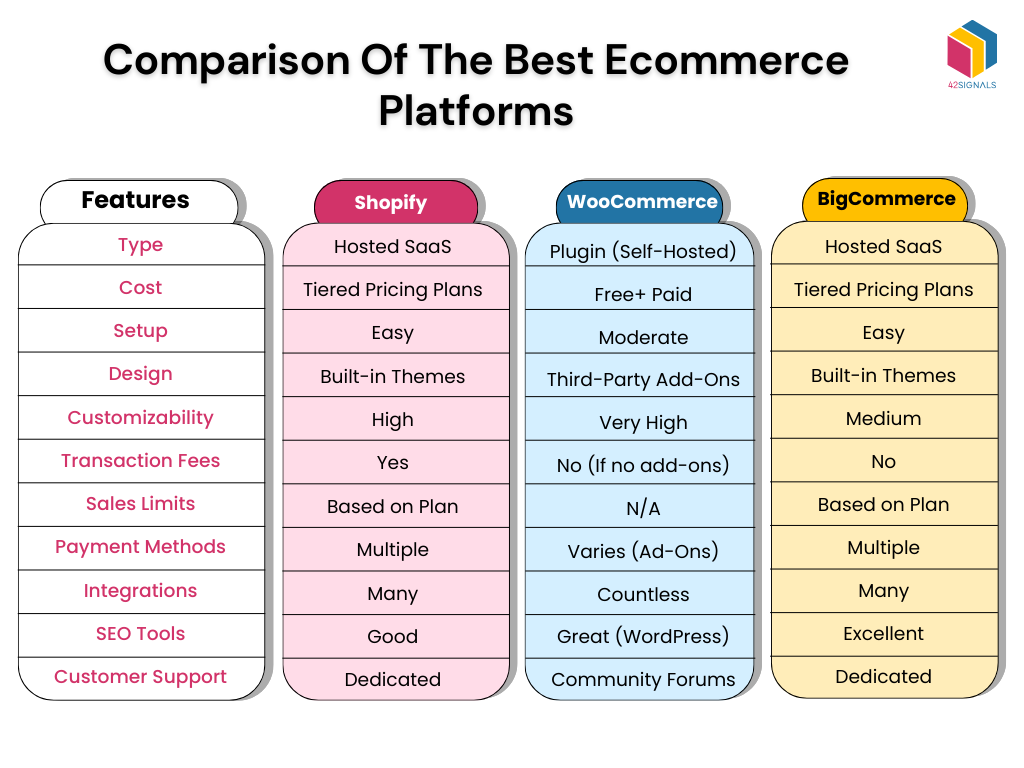
Image Source: 42Signals
Five platforms dominate when comparing ecommerce software options. Each serves distinct business models and technical requirements.
Shopify: Best Overall Ecommerce Platform
Shopify powers the ecommerce platform for small business operations through enterprise stores. The ecosystem has over 8,000 apps and allows merchants to add functionality without custom development. Shopify Sidekick, the AI assistant, streamlines store design and product listing creation. Plans range from USD 5 to USD 299 monthly, with 24/7 support. The checkout system converts at industry-leading rates, especially when using Shop Pay integration.
BigCommerce: Best for Scaling Businesses
BigCommerce maintains 100% uptime during every Cyber Week since 2016. The platform reduces app dependency by approximately 40% through native features and lowers monthly overhead. Multi-Storefront capability manages localized global stores from one dashboard. Pricing starts at USD 29 monthly when billed annually.
WooCommerce: Best for WordPress Users
WooCommerce runs over 4 million stores and is built on WordPress, which powers 43% of the internet. The core plugin costs nothing and offers complete data ownership with unlimited customization. WordPress Commerce hosting starts at USD 45 monthly. Technical expertise becomes needed as you scale beyond simple functionality.
Wix Ecommerce: Best for Beginners
Wix processes 45,000 transactions per minute with 99.99% uptime. The platform has 500+ templates and integrates with 80+ payment gateways. The Core plan starts at USD 29 monthly, with drag-and-drop design tools that require zero coding knowledge.
Magento: Best for Enterprise-Level Stores
Adobe acquired Magento for USD 1.68 billion, now serving 95,000+ stores globally. Merchants sold USD 155 billion worth of goods through Magento in 2019. The platform handles complex product catalogs and multi-warehouse inventory with custom enterprise integrations.
Choosing the Best Ecommerce Platform for Small Business
Small business owners face budget constraints that make platform selection critical. The monthly fee is just one piece of total ownership costs.
Budget-Friendly Options for Startups
Ecwid gives free plans for up to 5 products, and Square Online has a free version with unlimited product listings. WooCommerce eliminates licensing fees but needs separate hosting at USD 10-30 monthly. Shopify’s Basic plan starts at USD 29 monthly, and Wix eCommerce begins at USD 29 monthly. BigCommerce starts at USD 39 monthly.
Platforms with Low Learning Curve
Shopify, Wix, and Squarespace need zero coding knowledge. You set up stores through drag-and-drop editors without technical skills. WooCommerce needs development expertise or hiring specialists, as you handle updates and troubleshooting on your own.
Built-in Marketing Tools Comparison
Shopify has automated abandoned cart recovery emails and promotional campaigns. WooCommerce gives SEO optimization features to rank products higher. BigCommerce has multi-channel selling and native SEO tools. Wix delivers easy email marketing with automation.
Transaction Fees and Payment Flexibility
BigCommerce charges zero transaction fees whatever payment gateway you use. Shopify applies a 2% fee when using third-party processors. Payment processing costs 2.9% plus 30 cents per transaction. Square charges 2.9% plus USD 0.30 per sale.
Making Your Final Decision

Image Source: ECORN Agency
Your business goals should determine platform selection, not the reverse. Define whether you need to boost sales, expand internationally, or streamline operations before evaluating feature lists. Prioritize self-service capabilities like chatbots and knowledge centers if reducing customer support costs matters most. Growth-focused businesses require automation, advanced reporting, and multichannel selling capabilities.
Match Platform Features to Your Business Goals
Gather stakeholders from sales, marketing and customer service to arrange priorities. Companies that start with business objectives rather than technical specifications make better decisions. Identify pain points customers complain about most and opportunities that generate revenue. This exercise prevents selecting platforms that replicate existing problems.
Test Before You Commit
Free trials reveal usability issues product pages hide. Shopify offers a USD 1 trial with full platform access, whereas commercetools provides 60 days without automatic conversion. Test product uploads, checkout flows and payment gateway integrations during trials. Note that 29.6% of B2B customers call free trials the most influential purchase resource.
Migration and Long-Term Considerations
Phased migrations reduce risk compared to full platform switches. Start with an MVP approach and launch core features before advanced functionality. Clean your data before migration. Maintain backups throughout the process. Choose platforms that scale with catalog growth and international expansion plans.
Comparison Table
Ecommerce Platform Comparison Table
| Platform | Best For | Starting Price (Monthly) | Transaction Fees | Features | Technical Requirements | Notable Stats |
|---|---|---|---|---|---|---|
| Shopify | Overall best ecommerce platform | $5 – $299 | 2% when using third-party processors | • 8,000+ apps • AI assistant (Shopify Sidekick) • Industry-leading checkout conversion • Shop Pay integration • 24/7 support • Automated abandoned cart recovery | Zero coding knowledge required | • Hosts 1M+ stores • 28% of e-commerce worldwide • Up to 36% higher checkout conversion |
| BigCommerce | Scaling businesses | $29 (billed annually) | $0 (no transaction fees) | • 100% uptime during Cyber Week since 2016 • 40% fewer apps needed (native features) • Multi-Storefront capability • Multi-channel selling • Native SEO tools | Not mentioned | • 100% uptime track record • Reduces app dependency by ~40% |
| WooCommerce | WordPress users | $45 (WordPress Commerce hosting) | Not mentioned | • Complete data ownership • Unlimited customization • SEO optimization features • Core plugin is free | Requires coding knowledge and technical expertise | • 4M+ stores • Built on WordPress (43% of internet) • Separate hosting needed ($10-30/month) |
| Wix Ecommerce | Beginners | $29 | Not mentioned | • 500+ templates • 80+ payment gateway integrations • Drag-and-drop design • 99.99% uptime • Easy email marketing with automation | Zero coding knowledge required | • 45,000 transactions per minute • 99.99% uptime |
| Magento | Enterprise-level stores | Not mentioned | Not mentioned | • Complex product catalogs • Multi-warehouse inventory • Custom enterprise integrations | Not mentioned | • 95,000+ stores globally • $155B in goods sold (2019) • Acquired by Adobe for $1.68B |
Additional Budget-Friendly Options
| Platform | Starting Price | Main Feature |
|---|---|---|
| Ecwid | Free (up to 5 products) | Budget-friendly for startups |
| Square Online | Free | Unlimited product listings |
Payment Processing Baseline
Industry Standard: 2.9% + $0.30 per transaction (on most platforms)
Additional Fees to Think About:
- International conversion fees: 1.5% – 2% per transaction
- Third-party gateway fees on hosted platforms: 0.5% – 2%
- Typical app costs for scaling stores: $2,000 – $5,000 monthly
Conclusion
The right ecommerce platform depends entirely on your specific business needs and technical comfort level. Shopify delivers the best solution for most merchants, while BigCommerce suits businesses focused on growth. WooCommerce gives WordPress users complete control, and Wix makes launching effortless for beginners.
Free trials reveal what product pages cannot. Your business goals should drive the decision, not feature lists alone.
FAQs
Q1. Which ecommerce platform is best for beginners with no coding experience? Shopify and Wix are the top choices for beginners since both offer drag-and-drop editors and require zero coding knowledge. Shopify provides 8,000+ apps and 24/7 support starting at $29/month, while Wix offers 500+ templates with easy email marketing automation at the same price point. Both platforms handle technical aspects like hosting and security automatically.
Q2. What are the main hidden costs to watch out for when choosing an ecommerce platform? Beyond monthly subscription fees, expect transaction fees (typically 2.9% + $0.30 per sale), third-party payment gateway fees (0.5-2% additional), app costs ($2,000-$5,000 monthly for scaling stores), international conversion fees (1.5-2%), and PCI compliance charges. These costs compound quickly as your sales volume increases.
Q3. Is Shopify still the dominant platform in 2026? Yes, Shopify remains the leading platform, hosting over 1 million stores and capturing 28% of global e-commerce. It’s widely considered the best all-around choice for most merchants due to its ease of use, extensive app ecosystem, industry-leading checkout conversion rates, and ability to scale from small startups to enterprise-level operations.
Q4. When should I choose WooCommerce over Shopify? WooCommerce makes sense if you’re already using WordPress, want complete data ownership, need unlimited customization, and have technical expertise or developers on your team. While the core plugin is free, you’ll need separate hosting ($10-30/month) and must handle updates and maintenance yourself, making it better for cost-sensitive businesses comfortable with technical management.
Q5. How important is it to test a platform before committing long-term? Testing through free trials is essential since it reveals usability issues that product pages don’t show. Shopify offers a $1 trial with full access, while other platforms provide 30-60 day trials. During testing, verify product uploads, checkout flows, payment integrations, and third-party app connections to ensure the platform matches your actual workflow needs.