


What are backlinks?
Backlinks are hyperlinks from one website to another that point to a specific page or resource. The receiving website treats these links as incoming connections, while the site creating the link treats them as external or outbound links. The terminology varies across SEO contexts, with backlinks also referred to as inbound links, incoming links, inlinks, or inward links.
The directional nature of these links determines their classification. A website that places a hyperlink directing users to an external domain creates a backlink for the destination site. A British hedgehog website linking to a hedgehog sighting map exemplifies this relationship: the map receives a backlink from the hedgehog site, which appears as underlined, clickable text within the content. Links appear in blue and underlined format, though website owners retain control over styling priorities. Users can identify link destinations by hovering over them, which transforms the cursor into a pointer and reveals the target URL in the browser’s lower-left corner.
Search engines interpret backlinks as votes of confidence that indicate a page’s authority and relevance. Google’s original algorithm, known as PageRank, calculated scores for web pages based on their interconnections and established backlinks as a foundational ranking signal. This weighting system functions like citation analysis used for books, scholarly papers, and academic journals. Backlinks contribute to a site’s Experience, Expertise, Authoritativeness, and Trustworthiness (E-E-A-T), a key factor that Google uses to assess content quality.
Website owners acquire backlinks through two primary methods. Natural acquisition occurs as other sites find content and choose to reference it without solicitation. Proactive building involves outreach efforts and relationship development to secure links from relevant sources. The value of backlinks extends beyond search engine rankings to include referral traffic generation. Users click these links from external sites and direct themselves to the linked content, creating additional visitor pathways.
Search engines recognize that backlinks represent intentional editorial decisions. Algorithms assume the linking site has conducted some level of assessment before recommending the target webpage and treat the connection as validation of content value. The quality and relevance of backlinks carry more weight than quantity alone, with authoritative sources providing much greater effect than many low-value connections.
Why do backlinks matter for SEO?
Search engines assess website credibility and content quality through multiple signals, with backlinks serving as one of the most influential ranking factors. Research looking at competitive search queries found that 99.2% of top-ranking domains possess at least one external link pointing to their content. The volume and diversity of these connections directly associate with search visibility, as pages occupying the first position in Google contain an average of 3.8 times more backlinks than results ranked between positions two through ten.
Search engine rankings
The algorithmic weight assigned to backlinks stems from their function as trust signals within search engine evaluation systems. Google’s algorithm interprets links from authoritative websites as endorsements and distributes ranking value across the web through concepts like PageRank and link equity. Analysis of 200 competitive queries showed that 96.3% of high-ranking domains maintain 1,000 unique domain backlinks. More, top-performing pages acquire between 5% and 14% more followed links each month, showing sustained link growth as a characteristic of successful ranking performance.
Backlinks affect multiple ranking mechanisms beyond direct PageRank transfer. Links from fresh content sources improve crawl frequency and allow search engines to discover and index new pages faster. Consistent acquisition of new backlinks contributes to improved indexation rates, particularly for newer websites lacking internal signals that are well-established. Marketers identify backlinks among the top three most important ranking factors for local organic rankings.
Domain authority and trust
Domain Authority (DA) functions as a predictive metric that estimates a website’s likelihood of ranking in search results. Backlinks from authoritative, relevant sources boost DA scores by strengthening a site’s perceived credibility. The relationship between backlinks and domain authority operates symbiotically: when reputable websites link to content, search engines interpret the receiving site as a more valuable and authoritative source. High-authority domains linking to a site generate greater effect on DA scores than numerous low-quality connections.
A diverse link profile with multiple root domains boosts domain authority more than concentrated links from few sources. The variety of referring domains signals broader industry recognition and trust. Search engines recognize these patterns as indicators of genuine authority rather than manipulated link schemes.
Referral traffic
Backlinks generate direct visitor pathways independent of search engine results. When users click links from external websites, they direct to the linked content as referral traffic. These visitors show higher intent compared to general search traffic, as they arrive through contextual recommendations on topics arranged with their interests. Links from high-traffic websites provide ongoing referral flow as long as they remain active and create sustained visitor streams over extended periods.
Brand visibility
Backlinks from trusted websites in relevant niches expand brand exposure to new audience segments. Link building efforts with outreach and collaboration with industry influencers introduce brands to readerships that are well-established. Features on relevant platforms increase brand awareness and recognition and position the linked site as a resource within its field. Research on AI-generated search features shows that 75% of pages cited in AI Overviews rank within the top 12 organic results for corresponding queries, showing how backlink strength affects visibility across emerging search formats.
Types of backlinks
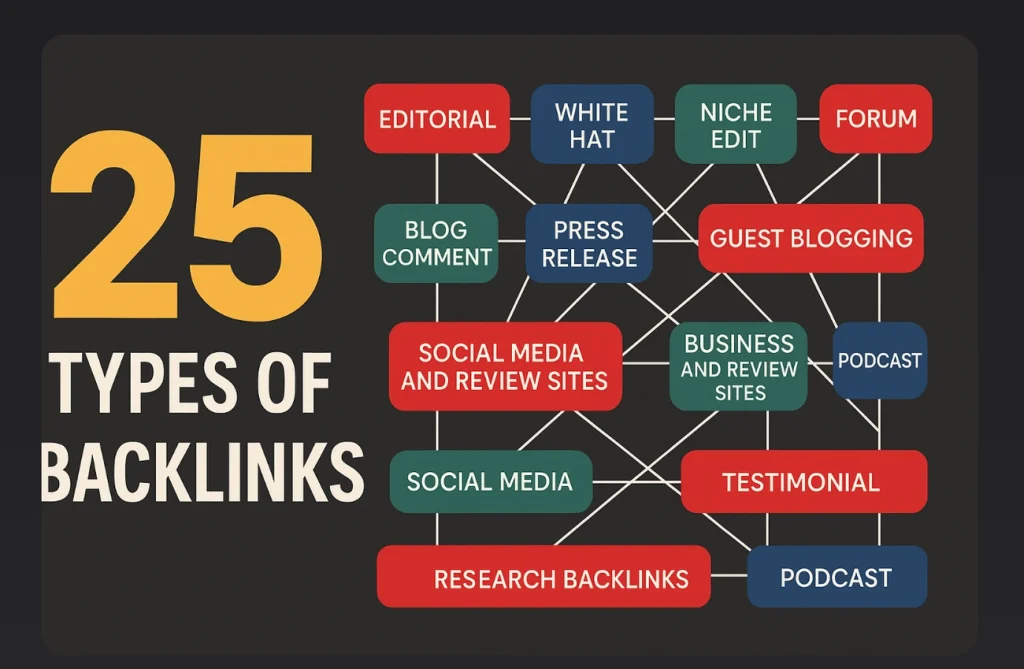
Image Source: Outreach Labs
How to build quality backlinks
Acquiring authoritative backlinks requires systematic approaches that prioritize editorial value over transactional link placement. Journalist outreach platforms provide direct access to media professionals seeking expert commentary and data sources. Tools such as Featured.com, Help a Reporter Out, and MentionMatch function as matchmaking services that connect subject matter experts with reporters writing articles. Journalists submit queries on topics of all types, and responses containing credible insights often result in published mentions with backlinks. Analysis of 1,000 journalist query responses showed consistent performance across these platforms.
Evidence-based content and original research turn pages into citation sources that journalists and content creators reference. A targeted statistics page developed during ChatGPT’s original popularity surge acquired 655 backlinks from 417 domains by providing data points journalists needed for AI-related articles. Original research, industry surveys and data analysis studies attract passive backlinks as other sites reference published findings. Complete guides designed as authoritative resources on specific topics earn citations when creators seek reliable information sources to support their content.
Guest posting strategies have evolved from link acquisition tactics to visibility and brand association methods. Effective guest posting focuses on publishers with audiences in relevant niches rather than targeting any site accepting contributed content. The approach emphasizes content creation that positions brands as solutions within tutorials, comparison articles or category recommendations. Pitches should address specific audience problems and show how the brand fits within that context.
Broken link building identifies outdated resources on competitor or industry websites that no longer function. Sites that have rebranded, migrated URLs or discontinued services often retain broken backlinks from other domains. Backlink checking tools reveal linking sites that may accept replacement suggestions when you analyze these defunct pages. Outreach to webmasters offers updated alternatives and provides value through improved user experience.
Unlinked brand mentions represent existing references lacking hyperlinks. Monitoring tools identify sites that mention brands, products or individuals without linking to official domains. Requesting link additions from these sources proves effective since the content acknowledges the entity already. Fixing broken backlinks pointing to nonexistent pages on owned domains involves identifying the broken URLs and contacting linking sites with updated destinations.
Partnership relationships with suppliers, platforms, customers and industry associations generate backlink opportunities through testimonials, member directories, partner sections and collaborative projects. Organizations feature client testimonials with attribution links or maintain member listings in industry associations. Joint research reports and co-created resources often receive coverage linking to participating entities.
Educational institutions, industry organizations and authoritative publications maintain resource pages that curate helpful links on specific topics. Search operators help identify relevant resource pages where you can propose content additions that place brands alongside other trusted sources. Digital PR campaigns create newsworthy content based on unique data or timely insights that attract journalist coverage and editorial backlinks when stories align with current news cycles.
How to analyze your backlink profile
Backlink profile analysis involves systematic assessment of incoming links to check website health and identify opportunities for optimization. Google Search Console provides the most reliable baseline data. The platform offers direct visibility into how Google perceives a site’s backlink structure. It displays top linking sites, most linked pages and anchor text distribution without requiring third-party subscriptions. Subscription-based tools including Ahrefs, Semrush, Majestic and Moz complement this data. They provide proprietary metrics and competitor comparison capabilities.
The analysis process begins with compiling a master spreadsheet that combines backlink data from multiple sources. Effective tracking systems use the linking URL as the main identifier, with adjacent columns for root domains and various quality metrics. Analysts should download backlink lists from Google Search Console and at least one additional platform such as Bing Webmaster Tools, Majestic Site Explorer or Ahrefs Site Explorer. This captures complete link coverage.
Majestic’s Trust Flow and Citation Flow metrics assess backlink quality through numerical scores ranging from 0 to 100. Citation Flow quantifies link equity based on the volume of sites linking to a domain. Trust Flow measures proximity to authoritative sources. Moz’s Domain Authority and Page Authority function similarly and estimate ranking potential on 100-point scales. Semrush calculates Authority Score using signals including backlink quality, organic traffic estimates and manipulation indicators.
Manual assessment remains vital despite automated scoring systems. Tools cannot check topical relevance and contextual appropriateness as well as human review. Analysts should examine whether linking pages relate to the target content’s subject matter. Irrelevant connections may trigger algorithmic scrutiny. Patterns of unnatural linking warrant particular attention, such as many unrelated sites linking to specific pages.
Toxic backlink identification focuses on spam scores, anchor text anomalies and suspicious referring domains. Links from low-quality sites, irrelevant foreign language domains or pages featuring unrelated anchor text require assessment for potential disavowal. The disavow file submitted through Google Search Console instructs the search engine to ignore specified backlinks when calculating rankings. Competitor backlink analysis reveals link building strategies and identifies domains linking to competing sites but not to the analyzed property. This exposes potential outreach targets.
Regular monitoring tracks new, lost and broken backlinks over time. Subscription tools provide alerts for significant profile changes and enable rapid response to spam attacks or sudden link losses.
Key Takeaways
Understanding backlinks is crucial for SEO success, as they serve as votes of confidence that directly impact search rankings and website authority.
• Backlinks are trust signals: Search engines treat links from other websites as endorsements, with 99.2% of top-ranking domains having at least one external backlink.
• Quality trumps quantity: Links from authoritative, relevant sources carry significantly more weight than numerous low-value connections for improving rankings.
• Focus on editorial value: Build backlinks through original research, journalist outreach, and creating comprehensive resources that naturally attract citations.
• Monitor your profile regularly: Use Google Search Console and third-party tools to track new links, identify toxic backlinks, and spot optimization opportunities.
• Diversify your link sources: A varied backlink profile from multiple root domains signals broader industry recognition and builds stronger domain authority.
The most effective backlink strategies prioritize creating valuable content that earns natural editorial links rather than pursuing transactional link placements. Regular analysis and monitoring ensure your backlink profile remains healthy and continues driving SEO performance.
FAQs
Q1. What exactly is a backlink? A backlink is a hyperlink from one website that points to another website. When someone clicks on this link, they’re directed to your site. These links serve as incoming connections and are also called inbound links or inlinks. They appear as clickable, usually underlined text within content.
Q2. Why are backlinks important for search engine rankings? Backlinks act as votes of confidence that signal your content’s authority and relevance to search engines. Research shows that 99.2% of top-ranking websites have at least one external link pointing to their content. Pages in the first position on Google contain an average of 3.8 times more backlinks than lower-ranking results, making them one of the most influential ranking factors.
Q3. What’s the difference between dofollow and nofollow backlinks? Dofollow links are regular links that pass ranking value and directly impact your search engine rankings. Nofollow links contain a special tag that tells search engines not to pass ranking credit. However, both types still count toward your backlink profile, and having a mix of both is actually more natural and beneficial than having only dofollow links.
Q4. How can I get quality backlinks to my website? You can acquire backlinks through several methods: creating original research and data-driven content that others want to cite, responding to journalist queries through platforms like HARO, writing guest posts for relevant industry websites, fixing broken links on other sites by offering your content as a replacement, and building partnerships with suppliers or industry associations that may feature your business.
Q5. How do I analyze my backlink profile? Start by using Google Search Console to see how Google views your backlinks, including top linking sites and anchor text distribution. Complement this with tools like Ahrefs, Semrush, or Moz to get additional metrics and competitor comparisons. Evaluate backlink quality by checking relevance to your content, domain authority scores, and identifying any toxic or spammy links that should be disavowed.